Sunday, 19 July 2009

à une bouchée

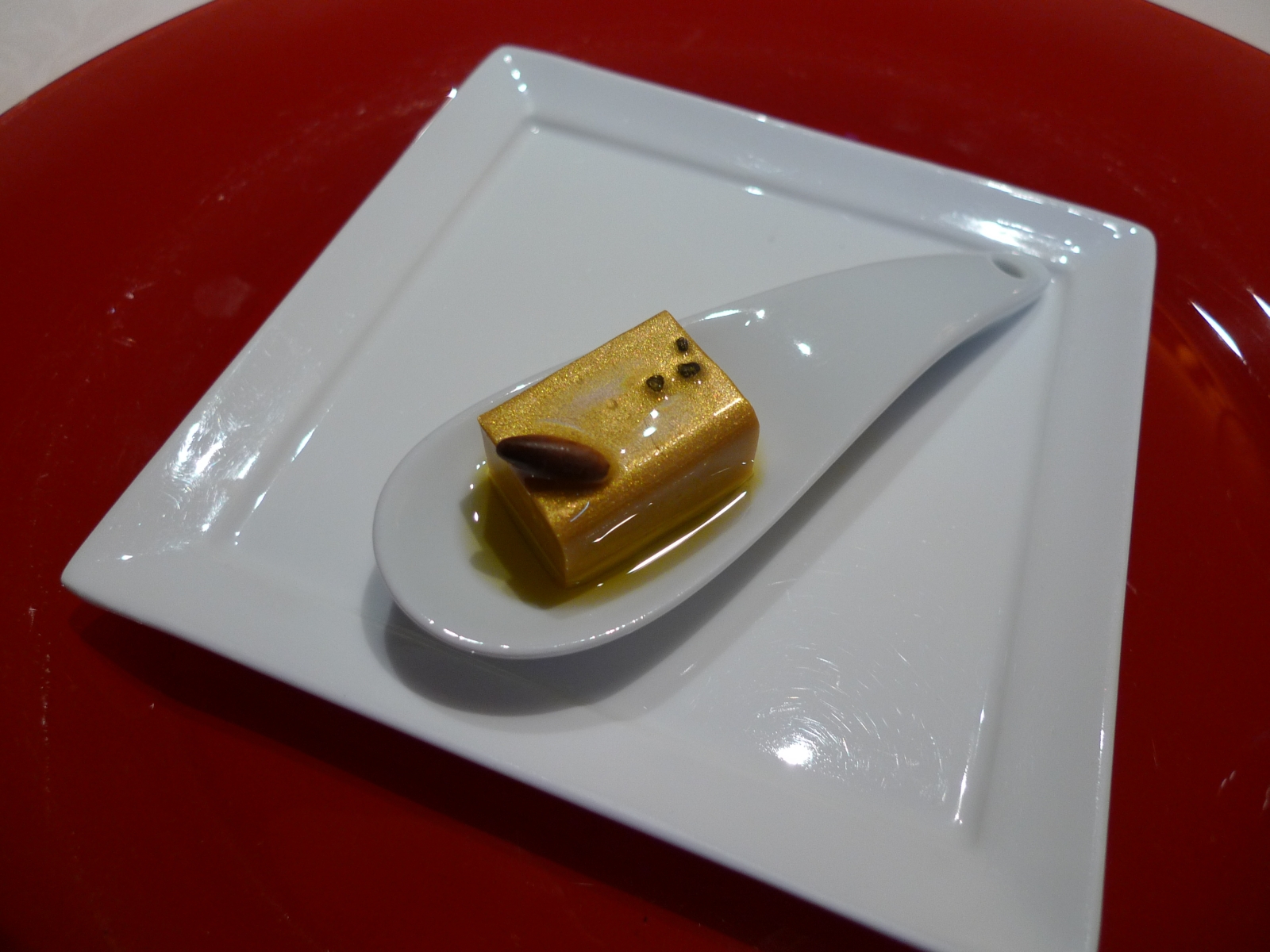
Yesterday evening we enjoyed a relaxed 25 course dinner at Denis Martin in Vevey. If you are facing 25 courses, not all are actually that big. Since the main emphases lies on the taste of the course, to each one specific instruction were given on how it had to be eaten to exploit it to the max. Some of them, like the Lingot d'Or (gold bullion) below, had to be eaten à une bouchée (in one bite).

Tuesday, 14 July 2009

tongue-in-cheek

I so hope it was a tongue-in-cheek statement, when a colleague of mine put this in our coffee room...


... however, I don't think it was one by the maniacs who came up with this poster in the first place.

Verve

I first came across the term verve by discovering the British band The Verve in the 90es. I did not even know that this French word is also used in the German language. However, since then, I use it with verve as often as I can.

Friday, 26 June 2009

Corniche

The word corniche comes from the French route à corniche or road on a ledge.

The word corniche typically refers to a road on the side of a cliff or mountain, with the ground rising on one side of the road and falling away on the other.

In Lebanon and Egypt, the word كورنيش typically describes a waterfront promenade usually paralleled by a main road, such as the renowned Corniche in Beirut or like on the picture in Alexandria.

حَبيبي

Almost 20 years ago, I was for the first time in an Arabic country (July 16.-29, 1989). I had actually planed to travel by train from Moscow to Hong Kong, however the Chinese authorities thwarted this by their massacre on the Tiananmen Square. Nevertheless, I never regretted going to Syria instead.

One of the phrases our guide often used was Yallah Habibi (let's go darling). The phrase kind of engraved itself into my brain and since then, I usually learn it as one of the first in a new language I encounter.

Habibi (حَبيبي) is an Arabic word that literally means my beloved (of a male; the female form is habibati, or colloquially habibti), from the adjective habib (beloved). It is commonly also used for friend, darling, and similar endearments.

And since I'm in Egypt let's listen to how Mohamed Fouad interprets it:

Friday, 19 June 2009

mise en place

Mise en place is a French term referring to having all the ingredients necessary for a dish prepared and ready to combine up to the point of cooking.

Like today, Toño had quite a stirring day at work (they were sold, his boss quit etc.). Thus I did the grocery shopping and made the mise en place so that Toño only had to perform his magic at the stove and select the wine.

Thursday, 18 June 2009

home made

home made is quite a strained expression, however, when it is presented at 30000 feet on an airliner and wrapped in cellophane it is nothing more than a blatant lie.